Jobs at Risk from AI: Microsoft Reveals 40 Roles and How to Future-Proof Your Career
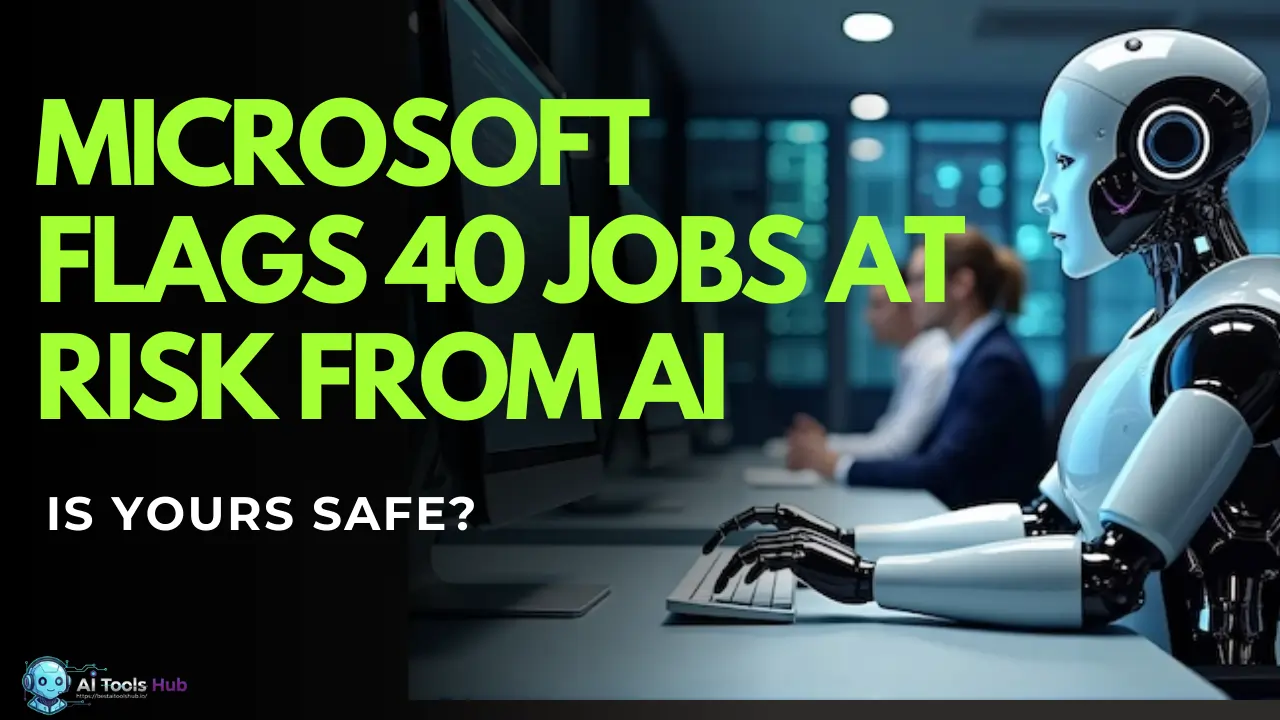
AI and the Future of Work: Microsoft Reveals Top 40 Jobs at Risk (With Tools to Protect Your Career) Microsoft’s bombshell report has everyone talking.
By dissecting over 200,000 real-world interactions with AI tools like Copilot, they’ve compiled the Microsoft AI jobs at risk list 2026—ranking 40 professions where AI could automate 50-80% of core tasks.
Here’s a jaw-dropper: despite the buzz, LinkedIn reports that high AI-exposure jobs grew 21% faster than average last year. Think writers dreaming up campaigns, sales pros sealing deals, or web devs coding sites—these aren’t safe anymore. But panic? Nah.
This list is your cheat sheet to future-proof your career before 2026 fully unfolds. Let’s break it down.
Inside Microsoft’s Wake-Up Call
Forget vague forecasts. Microsoft’s breakdown uses an AI applicability score jobs list to rate how deeply AI grips everyday tasks across 1,000+ jobs. They pored over real Copilot sessions, spotting where AI nails 50-80% of the grunt work—like emails or data crunching.
The shocker? It’s hitting brainy gigs hard, not just assembly lines. This ties straight into how AI affects the workplace 2026, per their AI job displacement research by Microsoft.
Jobs aren’t vanishing overnight—AI-exposed ones actually grew faster lately. But smart bosses are already folding tools like Copilot into teams. Bottom line: high scores scream “adapt or lag.”
Jobs at Risk from AI in 2026 (Microsoft’s Top Exposure List)
Microsoft’s AI exposure ranking highlights professions where AI can already take over a large portion of core tasks. These jobs aren’t disappearing — they’re evolving. Here’s a concise look at roles most exposed, and where humans still add value:
Creative & Media Roles:
- Writers and Authors
- Technical Writers
- Proofreaders and Copy Markers
- Editors
- Broadcast Announcers and Radio DJs
Customer & Service Roles:
- Customer Service Representatives
- Sales Representatives of Services
- Telemarketers – AI supports scripts;
- Ticket Agents and Travel Clerks
- Hosts and Hostesses, Concierges
Technical & Analytical Roles:
- Data Scientists
- CNC Tool Programmers
- Web Developers
- Statistical Assistants
- Economists & Mathematicians
- Market Research Analysts
Education & Professional Roles:
- Business Teachers, Postsecondary
- Library Science Teachers
- Farm and Home Management Educators
- Public Relations Specialists
- Political Scientists
Other Roles / Low-Exposure Examples:
- Passenger Attendants
- Historians
- Archivists
- Models
- Switchboard Operators
- Personal Financial Advisors
Flip the Script: Jobs AI Can’t Touch + Your Power Moves
Inside Microsoft’s Wake-Up Call Their AI applicability score jobs list rates jobs on AI’s task takeover potential, based on Copilot usage across industries.
It’s revealing how AI affects the workplace 2026 through AI job displacement research by Microsoft. Creative roles top the list—not just manual ones. Jobs won’t disappear; they’ll transform as companies integrate AI.
📊 Key Stats from Microsoft’s AI Jobs Report
When I first read Microsoft’s 2026 AI report, I was honestly surprised. It wasn’t the usual “AI will steal your job” hype. Instead, it showed something more interesting: AI is already doing parts of our work — and it’s doing it fast. Microsoft analyzed over 200,000 real interactions with Copilot to see which jobs AI touches most.
AI Can Already Help with Jobs
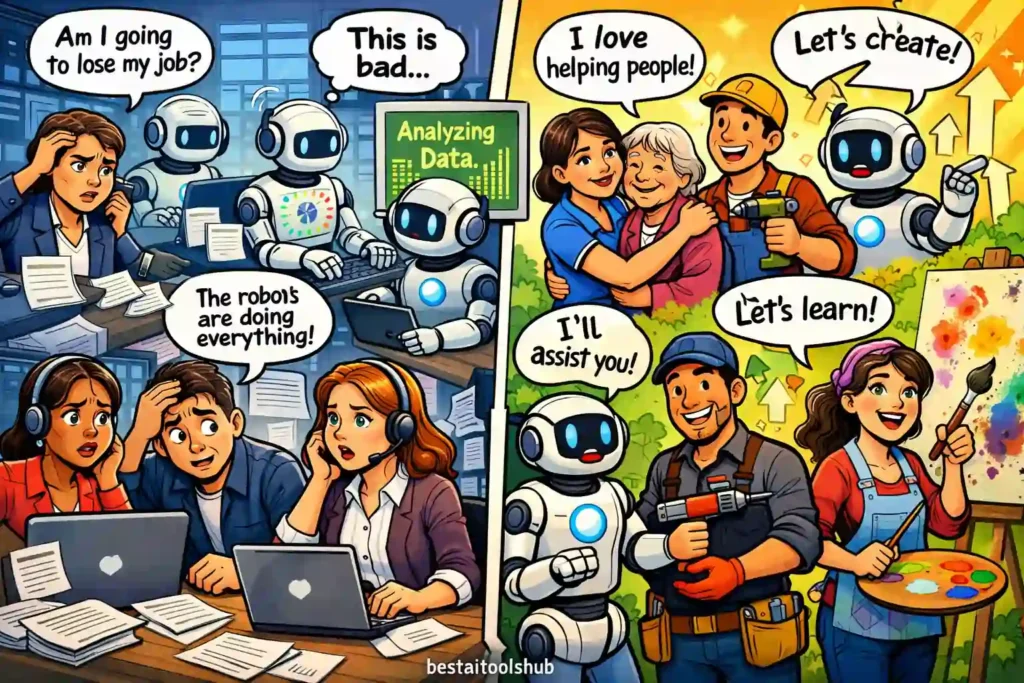
Consider positions such as customer service representatives, data analysts, and writers. According to Microsoft’s AI applicability score, 60–80% of everyday work can already be automated for some of these occupations. This implies that AI may now perform tasks like creating reports, responding to normal emails, and summarizing data. The worst part is that human empathy, inventiveness, and judgment are still indispensable.
AI-Savvy Roles Are Growing Faster Another surprising stat? Job postings asking for AI-related skills jumped 25% since 2024. People who learn to use AI tools — not just fear them — are getting more visibility and even higher pay. For some high-exposure roles, wages are growing twice as fast for professionals who upskill. It’s proof that learning to collaborate with AI is becoming a career superpower.
In the meanwhile, caregiving, some trades, teaching, and other professions requiring practical skills, sensitivity, or creativity are still generally safe. According to Microsoft’s data, those jobs have an AI exposure score of less than 0.3, which means AI can hardly affect the core of your work.
🚀 What People Are Using to Stay Ahead (No Hype, Just Reality)
Most professionals aren’t chasing trends — they’re simply trying to save time and avoid burnout. A few tools are quietly becoming part of everyday work:
Microsoft Copilot helps reduce time spent on repetitive work by organizing spreadsheets quicker, describing long conferences, and generating concise emails.
ChatGPT is a tool that supports thinking rather than replaces it. It can be used to generate ideas, enhance rough drafts, check logic in code, and get stuck when thinking hit a wall.
Notion AI: Without searching through files, it converts chaotic notes into concise plans, action items, and summaries.
Coursera and the LinkedIn Learning platform are quick learning courses that assist professionals in comprehending automation, basic concepts of data, and the role of AI in contemporary work.
No one will be completely protected by these tools. However, as you learn to collaborate with them, you continue to move while others remain motionless.
Most individuals are unaware of the speed that disparity accumulates.
🏁 Final Thoughts: Don’t Fear the List — Use It
Microsoft’s AI exposure list isn’t a warning siren — it’s a roadmap. It shows exactly where automation is accelerating and where human creativity, judgment, and emotional intelligence still dominate.
If your job appears on the list, that’s not bad news. It means you’re standing close to powerful tools that can amplify your impact — if you learn to use them early. The professionals who adapt now will shape the next decade of work, while others play catch-up later.
The future of work with AI and career resilience strategies isn’t about hiding from change — it’s about riding it with confidence, curiosity, and smart skills.
Your career isn’t at risk. Staying still is.

Lucia Hoerner is a tech writer at BestAIToolsHub.io, focused on AI tools, software reviews, and practical use cases. She enjoys turning complex technology into clear, helpful content for everyday users. With a passion for innovation and clarity, she helps readers discover AI tools that truly add value.


Leave a Reply