
Tesla Robotaxis Without Drivers Are Here — How AI Drives the Future of Transportation
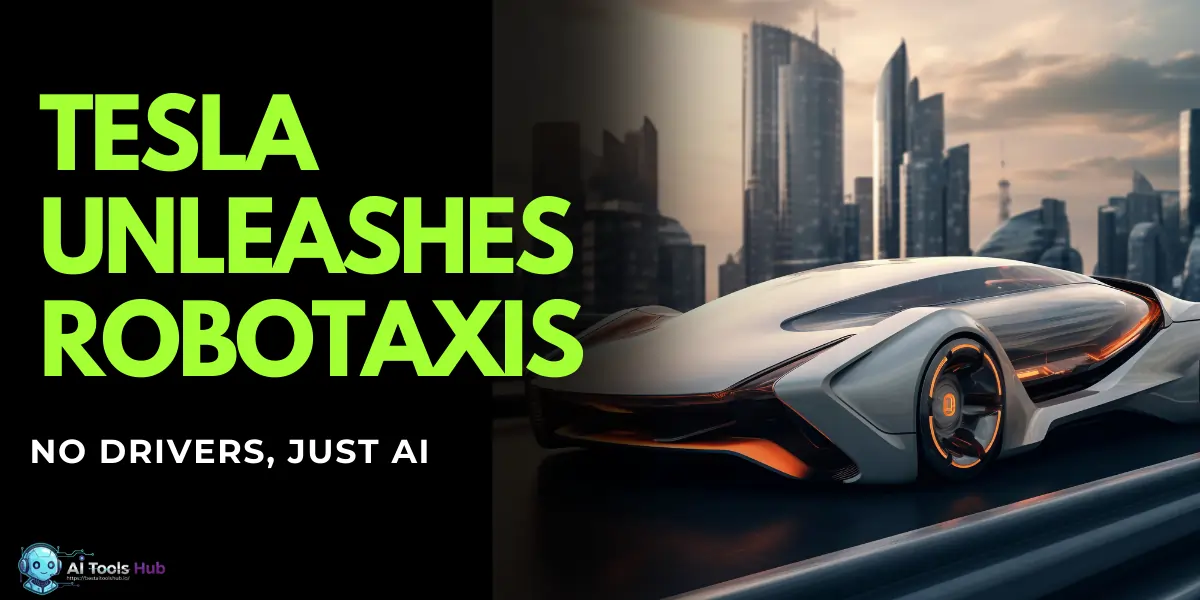
On a quiet stretch of Los Angeles streets this week, a Tesla pulled up to collect its first official passengers — with no driver inside. The company’s long-promised robotaxi service began operating with vehicles that drive entirely on their own, guided by artificial intelligence systems rather than human reflexes.
The launch is limited, but real. A few dozen cars are now moving through city traffic, responding to signals, pedestrians, and merging lanes without anyone behind the wheel.
After years of testing and cautious regulation, autonomous driving has left the lab and entered everyday circulation. What used to be a future headline is now part of the morning commute.
How These Robotaxis Actually Work
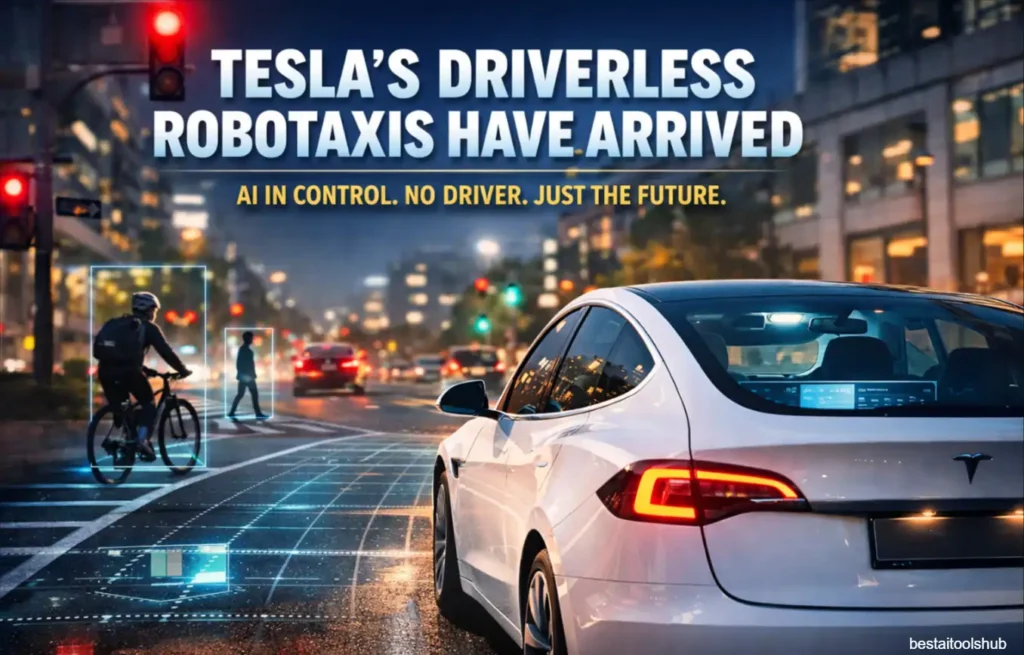
A driverless vehicle doesn’t perform magic. What it does is process everything it sees — road lines, traffic lights, angles of sunlight, a cyclist in the periphery — through layers of mathematical models built from experience. Cameras and sensors feed streams of data into what Tesla calls its autonomous driving AI, an arrangement of neural networks that imitate how humans recognize patterns and react to them.
These systems don’t “understand” in a human sense; they correlate. They’ve been trained on countless hours of footage, identifying how streets behave, what movement predicts risk, and where hesitation might cause confusion. When the car drives, it’s combining perception with prediction — seeing and guessing at the same time. Each journey also teaches the network something new, refining how future robotaxis will handle the same stretch of road.
In plain terms, the cars operate by replacing human judgment with statistical prediction, and so far, those predictions are accurate enough to stay between the lines.
Why Removing the Driver Changes Everything
Taking the human out of the driver’s seat doesn’t just alter a vehicle; it shifts the relationship between people and movement. There’s no small talk, no eye contact, no one to blame or thank. Passengers sit quietly in a car that appears alive in its own way. Responsibility is displaced — shared among engineers, regulators, and code rather than a single licensed driver.
The experience can feel both astonishing and unsettling. Humans have always measured safety through presence — someone at the wheel, hands ready, eyes scanning the road. In a robotaxi, safety becomes invisible, expressed as code lines and driving logs instead of instinct. For some, that may take time to trust. For others, the absence of human error might feel like a relief.
Safety, Oversight, and the Questions Still Open
For regulators, the questions are as much philosophical as technical. Who is responsible if something goes wrong — the company, the passenger, or the algorithm? Tesla, like others in the space, says its driverless vehicles are thoroughly tested and monitored, but policy still trails behind technology. Cities that allow robotaxi services often do so under pilot frameworks rather than permanent certification.
Public reaction is mixed. Many people accept the inevitable direction of AI in transportation, yet remain uneasy about edge cases — the unpredictable intersection or the sudden power outage. Accidents involving other self-driving cars in real traffic have already tested public patience. True acceptance may come only when these vehicles blend into daily life without incident, which takes time and transparency, not promises.
What This Signals for Transportation
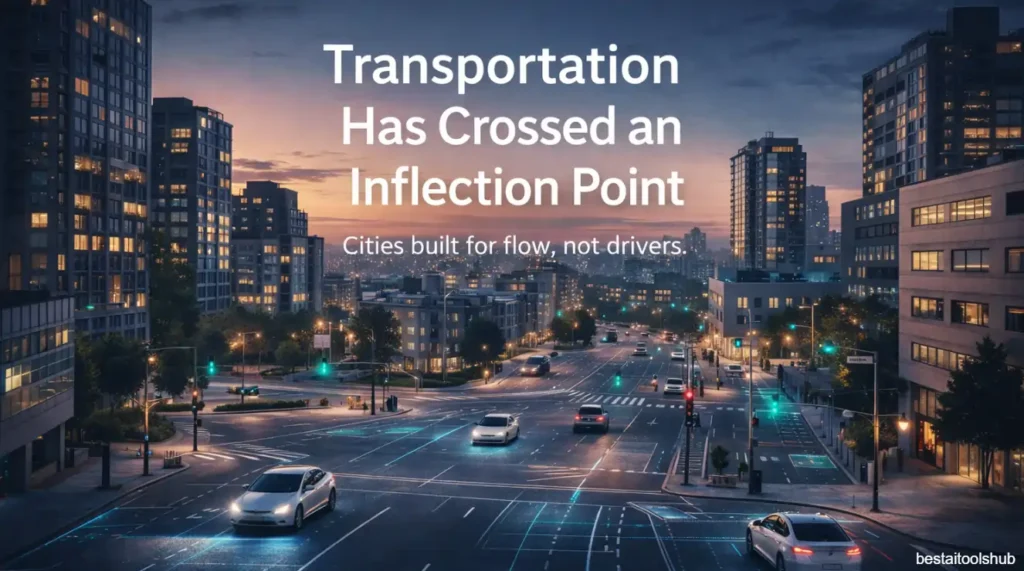
The sight of a car driving itself isn’t a spectacle anymore; it’s an inflection point. Transportation, long shaped by human schedules and fatigue, is beginning to operate on non-human logic — consistent, data-fed, and always awake. Urban mobility may slowly drift toward shared fleets managed by software, challenging the idea of personal car ownership and even parking space design.
If this transition holds, cities could evolve around flow rather than storage: fewer idle cars, more vehicles constantly moving. Yet each improvement carries trade-offs — reduced jobs in driving, new dependencies on software integrity, and unseen energy demands from keeping fleets online. The shift to autonomy may prove as social as it is technological.
What Happens Next
Tesla’s rollout remains small, confined to controlled routes with heavy supervision. The company plans gradual expansion as confidence grows, and other automakers are preparing their own entries into the driverless market. Progress will likely feel uneven — moments of smooth precision followed by pauses for review, regulation, and public adaptation.
For now, the roads are still mixed: human drivers beside machine ones, both learning in proximity. The directions Tesla’s cars follow aren’t all that matters. The rest of us are learning, too — trying to understand what it means when the person in control isn’t a person at all.

Mary Alexander is an AI tools researcher at BestAIToolsHub.io, specializing in evaluating emerging software and real-world use cases. She focuses on testing, comparing, and analyzing AI tools to identify what truly works. Her research-driven approach helps readers make informed, confident decisions in the fast-evolving AI landscape.


Leave a Reply