What Is Vibe Coding? The Future of AI-Driven Software Development in 2026
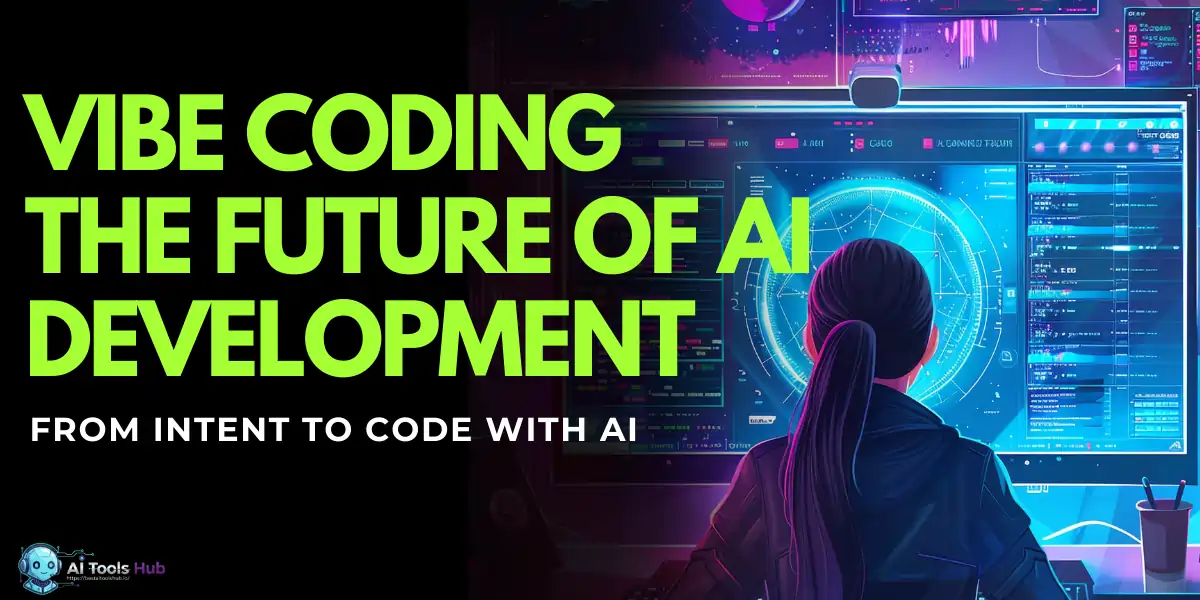
A slang term on X a few months ago, “Vibe Coding” is now a serious signal of where AI-driven development is heading.
Vibe Coding has gone from an in-joke on developer Twitter to a formally defined AI-assisted technique that major vendors and enterprises are now taking seriously.
Coined by Andrej Karpathy in early 2025, it describes a shift where developers talk to AI about what they want and let autonomous coding agents handle the implementation. For the software industry, this is more than branding: it crystallizes a new era of AI-driven development, where intent-based programming, AI coding tools, and automated software workflows start to redefine what “writing code” even means.
What Is Vibe Coding?

At its core, Vibe Coding is a style of programming where a developer (or even a non-developer) describes the desired behavior of an app in plain language and lets a large language model generate, modify, and debug the code with minimal manual editing.
Instead of stepping through every function, the human focuses on intent what the product should do, how the user should feel, what workflow should exist—while the AI handles the syntax, scaffolding, and machine learning programming under the hood.
Crucially, Vibe Coding is not just “using autocomplete more.” It assumes the developer rarely inspects individual lines and instead evaluates the system by running it, checking logs, tests, and UX, then iterating through more natural-language prompts. That’s a sharp break from traditional AI coding tools, where suggestions are treated as drafts to be carefully reviewed and integrated by hand.
Real-world “vibe” scenarios already look familiar:
This is intent-based programming in practice: the unit of work is no longer a function or pull request, but a conversation about outcomes.
How Vibe Coding Works
Under the buzzword, Vibe Coding is a layered stack of LLMs, context tools, and automation features wired into modern development environments.
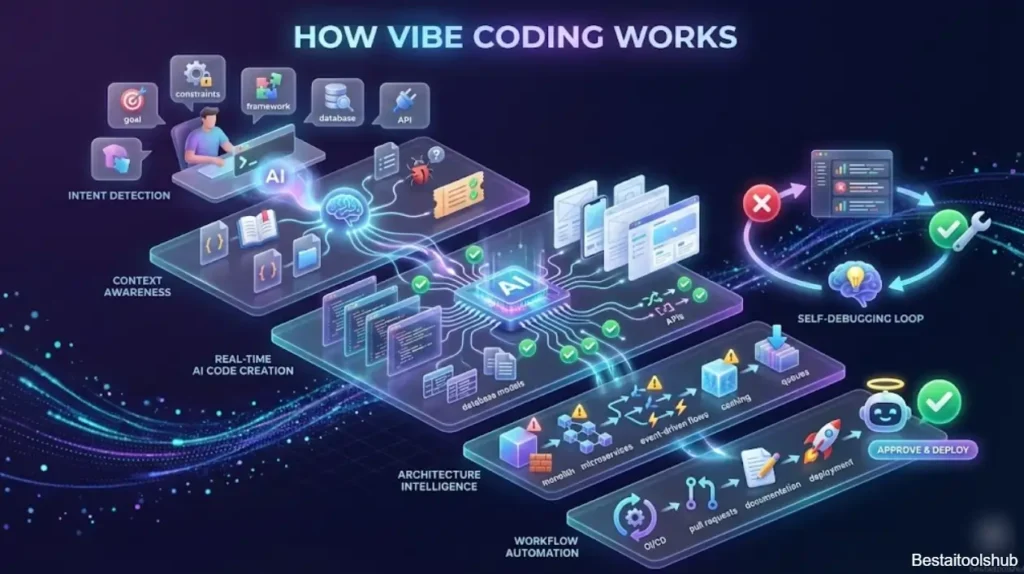
Intent detection
Real-time AI code creation
Self-debugging
Architecture suggestions
Workflow automation
Why Developers Are Shifting to AI-Driven Coding
Developers are not embracing Vibe Coding because they suddenly dislike code; they’re doing it because classic workflows cannot keep up with product and platform demands.
First, there’s raw output. AI code generation slashes time spent on boilerplate, integration glue, and repetitive patterns, which historically eat a large share of engineering hours. Teams can move from idea to functional prototype in hours instead of sprints, which is a huge advantage for startups racing competitors and for incumbents trying to ship experiments without bloating headcount.
Second, Vibe Coding reduces cognitive overhead. Rather than loading an entire codebase into their head, developers offload much of that mental state to AI coding tools that can search, summarize, and reason across thousands of files at once. That shift makes complex systems more approachable, especially for newer engineers joining large legacy stacks.
Third, it democratizes building. No-code & low-code trends already opened the door for non-engineers; Vibe Coding pushes that door wider by letting product managers, analysts, and designers participate directly in creating features using natural language. Professional developers still own architecture and governance, but more people can now contribute working software.
Industry Impact + Data Insights
Zooming out, Vibe Coding is reshaping software economics and the future of programming in ways that analysts, CIOs, and engineering leaders are trying to quantify.
Early data from AI development studies and vendor benchmarks point to substantial productivity gains. Multiple reports suggest teams using AI-driven development and Vibe Coding–style workflows see 30–55% faster completion times on typical feature work, with the biggest wins in boilerplate, configuration, and API integration tasks. One analysis of AI code tools forecasts the global market for these platforms to exceed roughly $25 billion by 2030 as they become standard in both enterprises and startup stacks.
Adoption trends show that AI coding tools went mainstream before the phrase “Vibe Coding” existed. Surveys cited by industry observers report that by 2023–2024, over 40% of developers were already using AI assistants for tasks like code completion, debugging hints, documentation, and test generation. More recent Vibe Coding–specific snapshots show even non-developers making up a growing share of users, especially in UI building and internal tools.
There is also a clear sentiment split. Many engineers report feeling “supercharged” when AI handles drudge work, but a non-trivial minority admits they sometimes deploy AI-generated code they don’t fully understand. Security and compliance leaders, meanwhile, warn that AI-assisted speed must be balanced with robust guardrails, code review, and policy to avoid hidden vulnerabilities and licensing landmines.
These dynamics make Vibe Coding a prime topic for research citations and conference talks: the numbers are impressive, but the long-term engineering culture implications are still unfolding.
Tools Powering Vibe Coding
Vibe Coding isn’t tied to one IDE, but some tools are clearly optimized for this intent-based programming style. Developers experimenting with vibe-style workflows often rely on tools like Cursor AI, which can understand the entire codebase, answer questions about it, and generate multi-file changes that align with the requested behavior end-to-end.

Cursor AI is built as a VS Code–compatible editor with native AI integration, combining chat, code generation, refactoring, and project-wide context in a single workspace rather than bolting AI on as just another extension. In practice, that means a developer can say “add email verification, handle edge cases, and update the docs,” and see changes proposed across backend, frontend, tests, and markdown files in one pass.
For teams testing the waters, editors like Cursor make Vibe Coding less theoretical and more like a daily habit: you open the project, talk to the AI about what needs to happen, and let it drive the first draft of the change while you focus on whether the behavior matches the product goals.
Expert Viewpoint
Analysts tracking AI-driven development see Vibe Coding as the visible tip of a much deeper shift: the move from code-centric to intent-centric software engineering. Rather than treating AI as a sidecar that occasionally suggests snippets, they argue, organizations will increasingly design processes where AI agents are the default executors of routine coding and humans step in as reviewers, architects, and product strategists.
Developers themselves are more ambivalent but broadly pragmatic. Many suggest that the real benefit of Vibe Coding is not just speed, but the ability to explore more options—different architectures, libraries, or UX flows—in the same time it once took to build a single implementation. At the same time, experienced engineers warn that teams that fully “forget the code exists” risk technical debt, security gaps, and brittle systems that are hard to debug when AI is offline or wrong.
The consensus emerging in expert circles: Vibe Coding is powerful when layered on top of strong engineering discipline and dangerous when used as a shortcut to skip that discipline entirely.
Future of AI-Driven Development
Looking ahead, Vibe Coding is likely just the first widely recognized label in a broader move toward AI-first engineering practices.
In that world, Vibe Coding is less a gimmick and more a training ground: it teaches developers how to collaborate with autonomous coding agents, articulate intent clearly, and design systems that can evolve safely under continuous AI assistance.
Conclusion
Vibe Coding captures a cultural moment where coding feels less like wrestling with syntax and more like directing a very capable, occasionally chaotic, AI teammate. The organizations that will benefit most are not the ones chasing the buzzword, but those quietly redesigning their workflows, guardrails, and skills around a future where AI-driven development is the default, not the exception.

Mary Alexander is an AI tools researcher at BestAIToolsHub.io, specializing in evaluating emerging software and real-world use cases. She focuses on testing, comparing, and analyzing AI tools to identify what truly works. Her research-driven approach helps readers make informed, confident decisions in the fast-evolving AI landscape.

Leave a Reply